

At 7:30 you are already in a chat with a supplier. Before lunch — a driver to replace, a customer complaint, an advance payment for a contractor. After lunch you promise yourself you will finally sit down with the strategy, but the bookkeeper arrives with a question only you can answer. At 21:00 you are replying to email and realise the day has been eaten by operations again. Your last holiday was two years ago — because “without me everything stops”.
If that sounds like your week, you do not have a discipline problem or a time-management problem. You have a business that rests on its owner. This is a normal stage for a company of 5–25 people — and at the same time the ceiling that limits both growth and your health. This guide is about why it happens, how to recognise the moment when operational overload turns into burnout, and what to do specifically if you work 60 hours a week and want a way out.
A word about expectations first. We deliberately do not quote a percentage of “time freed up” here — we have no verifiable figure of our own, and we are not going to repeat somebody else’s promises. What is realistic is different: after a few months of work on structure, you stop being the single point every decision has to pass through. Here is what that consists of.
Why everything rests on the owner: five real causes
“It is all on me” is not a personality trait. It is a consequence of how the business was built. In the early years the owner was the system: he knew the clients, the prices, the suppliers, how to fix the equipment and who could be trusted to pay later. That worked while there were three people. At 10–25 people the same model starts to break — and here is why.
1. There is no org structure — so everyone is responsible for everything
Ask yourself: if you drew a diagram of your company, could every employee say who their manager is and which result they are personally accountable for? In an owner-dependent business the answer is usually “well, everyone goes to the owner”. When areas of responsibility do not exist on paper, they exist only in your head, and every question naturally escalates to you. It is not that people lack initiative. It is that you are the single point where all the information meets.
2. You delegate tasks, not authority
The classic trap: you hand someone a task — “sort this client out” — but not the right to make a decision, spend money or say no. The person comes back to you with every “may I?”, you get frustrated that “it is quicker to do it myself”, and you do it yourself. A task without authority exhausts both sides and leaves the employee feeling powerless. After a few such cycles the team learns the main lesson: decide nothing without the owner.
3. There are no written procedures — only “the way I showed you”
How do you take a new order? How do you process a return? What happens when a supplier misses a deadline? If the answer lives in your memory and in verbal explanations, every new hire learns from you personally, every non-standard situation is yours again, and quality depends on who happens to be on shift. A written procedure is not bureaucracy. It is the way to make sure the right decision gets made without you.
4. The numbers are visible only to the owner
In many companies of 5–25 people, management accounting is an owner who “roughly knows”. How much was earned this month, which product carries the margin, whether there will be enough for payroll on the 5th — the owner works it all out in his head or in a single spreadsheet. Heads of departments are not shown the numbers, which is exactly why they cannot be accountable for results: you cannot demand profit from someone who cannot see the cost.
5. The habit: “nobody will do it better than me”
The most honest cause. You really do it better — for now. But “better” here costs you your evenings, your weekends and the growth of the company. Micromanagement is a habit rather than a necessity, and it rests on fear: let go of the wheel and everything falls apart; hire a director and they will “steal it or ruin it”. That fear is justified exactly as long as the company has no structure, no procedures and no numbers that let you keep control without being present. In other words, the first four causes create the fifth.
Picture a situation — this is not a specific client’s case but a typical scenario. The owner of a small manufacturing business with fourteen employees handles purchasing himself, approves every shipment himself and keeps the prices for “his” clients in his head. When he goes to a trade fair for two days, the warehouse stops shipping — not because the team cannot, but because they are not allowed to. When he comes back and spends one evening writing down on a sheet of paper who is responsible for the warehouse, who may sign off a shipment up to a certain value and what the rules for pricing are, the number of queries reaching him on that subject drops sharply. Not because the people changed. The rules changed.
Signs of owner burnout: when operational load becomes dangerous
“It is all on me” feels tolerable for a long time. The danger is that owners usually miss the moment when overload turns into burnout — because “this is just a difficult period right now”. The difficult period is in its third year. Here is what to watch for.
Signals at work
- You cannot remember the last time you did something that was not firefighting. Strategy, product, hiring strong people — all postponed “until next month” for several years now.
- You get irritated with the team over questions you never allowed them to decide. A classic sign: you want people to take responsibility and take it away the moment they try.
- Decisions come more and more slowly. You put off even simple things — not because they are difficult, but because there is no capacity left for them.
- The company has not grown for two or three years, although the market allows it. Your time is the bottleneck: you physically cannot handle more clients, more orders and more people.
Signals in life
- A holiday — “you must be joking”. Or you are on holiday with a laptop and a phone, and everyone at home knows it.
- A 60–80 hour week has become normal and you have stopped noticing. The people close to you notice.
- Tiredness does not lift after the weekend. Monday starts at the same level of exhaustion that Friday ended on.
- You think of the business as something holding you hostage. “I am a hostage of my own business” is a sentence owners say out loud much later than they start feeling it.
An important caveat: we are not doctors, and this article is not medical advice. If you recognise most of these points and feel you are not coping, that is a reason to talk to a professional, not only to redesign your org structure. But from a business point of view the conclusion is singular: owner burnout is not a personal weakness, it is a direct consequence of how the company is built. While everything rests on you, the company’s resilience is limited to your own.
What to do if you recognised yourself
Not “take a holiday” — you already know that without structure everything comes back afterwards. Three steps that reduce the load within a month:
- Measure where your time actually goes. One week, honestly, in half-hour blocks: what you did, and whether somebody else could have done it if they had been allowed to. Owners doing this exercise for the first time are usually surprised to find that a noticeable share of the week goes on tasks that require not their expertise but merely their permission.
- Pick one process and close it with a written procedure. Not the whole company — one. The one people come to you about most often. Describe it on a single page: who, what, when, under which rules, and in which cases to escalate to you. Hand it over together with the right to decide.
- Appoint one person who makes decisions when you are away. Even if you are not ready for a managing director yet. One deputy with clearly defined limits of authority — and the company survives your two-day trip without phone calls.
Another typical scenario. The owner of a chain of three service points notices that for the past six months she has been answering work chats until midnight and cannot recall in the morning what she actually decided. She logs her week and sees that most of those messages come down to three things that could be covered by rules: approving discounts, replacing technicians and buying consumables. She writes three one-page procedures, gives the administrators the right to act within the rules and to escalate only exceptions. A month later the evening chats have not disappeared — but they have shifted from “what should I do?” to “done, for your information”.

The owner works 60 hours a week: the solution that works
Here we reach the main point. “Delegate more” does not work — you have tried. “Hire a director” without structure ends with one more subordinate coming to you for every decision. The answer to a 60-hour week is not heroism and not another time-management system. It is a structure: an org chart, written procedures and financial visibility that work without you in the room. Here is what it consists of and in which order to build it.
Step 1. Draw the org structure you have, not the one you want
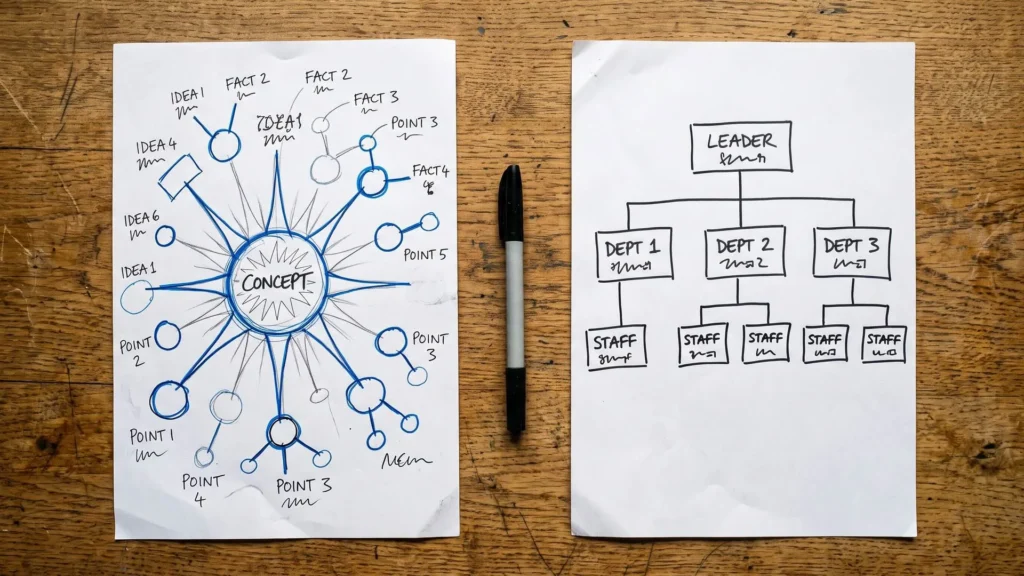
Take a sheet of paper and draw how the company actually works: who assigns tasks to whom, who is responsible for what, who people go to with questions. In most owner-dependent businesses the diagram looks like a sun: the owner in the centre and every ray leading to him. That is the diagnosis. Now draw a second diagram — with 3–5 functional areas (sales, production or service, finance, purchasing, marketing) and one person accountable for each. Not a job title — a name. If your own name sits in three boxes, that is normal at the start; what matters is that you can now see which functions to take off yourself first.
Step 2. Describe 5–7 key processes as one-page procedures
You do not need to describe everything. You need to describe what brings in money and what breaks most often: how an order arrives and is processed, how a new employee is onboarded, how materials are purchased, how complaints are handled, how prices are set. The format is simple: the purpose of the process, the steps, who is responsible for each step, which decisions the person makes alone and which go to a manager. One page. If it does not fit, the process is not yet clear to you either — which is also useful to discover.
Step 3. Hand over authority together with the task
Every procedure should contain limits: up to what amount a person decides alone, what discount they may offer, whom they may hire or dismiss. That is delegation that works: not “sort it out”, but “you decide within these limits, and I will not overturn your decision after the fact”. The last part is the hardest for the owner and the most important for the team. If you overturn decisions you delegated yourself, within a month people will go back to “I will ask the owner”.
Step 4. Put in place numbers that more than the owner can see
Minimal management accounting: a weekly report on income and expenses, margin by area, receivables, a monthly plan. Not for the bank — for your heads of departments. Someone who can see what their area brought in over the month and what it cost begins to behave like a person accountable for a result. Someone who sees only a task list behaves like an executor.
Step 5. Introduce a management rhythm instead of constant availability
One weekly meeting with the heads of departments on a fixed agenda: last week’s numbers, problems, decisions, plan. One report by email on Friday. Everything else runs on the written procedures. This replaces dozens of daily “have you got a minute?” interruptions with a single hour and gives you what you were missing most: predictable time for strategy.
How long does it take? Doing it alone, alongside operations, takes three to six months — and the most common outcome of doing it alone is that half gets done before day-to-day work pulls you back. That is exactly why owners join systematisation programmes with a live group and deadlines: not for the knowledge (they have read enough books) but for implementation by a deadline. In the MBPS business systematisation course these same steps are covered in 12 weeks in a mini-group of up to 12 owners, and the output is an org structure, written procedures and a document pack built around your business rather than around a training example.
And a third typical scenario. The owner of a distribution company with just over twenty employees works 65–70 hours a week and cannot open a second warehouse because he “cannot be in two places at once”. Over three months he takes the five steps above: a diagram with four areas, seven written procedures, authority limits for two managers, a weekly report with margin by category and one Monday meeting. The working week does not become 40 hours. But the fires move to the heads of departments, and days appear in the owner’s calendar that he spends finding premises and negotiating the second warehouse. That is what freed-up time actually looks like: not rest, but the owner doing an owner’s work instead of a dispatcher’s.
Where to start this week: a five-day plan
You do not have to do everything at once. Here is a sequence that produces a first tangible result within a single working week — without consultants and without stepping away from the business.
| Day | What to do | Time needed | What you get |
|---|---|---|---|
| Monday | Start logging your time: record in half-hour blocks what you did and whether somebody else could have done it if they had been allowed to | 10 min a day | An honest picture of where your time goes, within a week |
| Tuesday | Draw the org structure “as it is” (the sun with you at the centre) and “as it should be”, with 3–5 areas and names | 1.5 hours | A list of the functions to take off yourself first |
| Wednesday | Pick the process people come to you about most often and describe it as a one-page procedure with limits of authority | 2 hours | Your first written procedure and first real delegation |
| Thursday | Put together a minimal financial report for last month — income, expenses, margin by area — and show it to your managers | 2 hours | People see the numbers they are accountable for, for the first time |
| Friday | Schedule a weekly meeting with a fixed agenda and appoint one deputy “for when you are away”, with defined limits | 1 hour | A management rhythm instead of constant availability |
After a week you will have a time log, two diagrams, one written procedure, one report and one routine. That is not a system — it is its first layer. But it is the layer that shows whether you are ready to hand things over and whether the team is ready to take them. If the week made things easier, you are on the right track, and the only question is whether you will finish it on your own.
Next: alone or in a group
The honest answer: everything described above can be done on your own. Owners who see it through by themselves do exist. But more often the scenario is different — the first two steps get done on enthusiasm, and on the third one day-to-day work wins again, because nobody asks “where is that procedure?” on Friday.
That is what the live group format is for: up to 12 owners, practitioner tutors, work on your own business and a project defence at the end. Not to learn something new, but to reach the end with a finished document pack. The MBPS programme runs for 3 months — 12 sessions of 120 minutes, once a week; the online format costs $3,400. The course suits both owners of an existing business and those who so far have only a business idea.
If you are not sure whether this is your case, have a look at the answers to common questions about the format, the language of the groups and the certificate.
Check how much your business rests on you
The fastest way to move from reading to doing is to answer nine questions about your own company: how many hours you spend on operations, how many people are on the team, which tasks are delegated and which are not. It takes two minutes, and at the end you get a personal assessment of where exactly to start systematising in your case. A real person replies, not an autoresponder.
Take the test: “How ready is your business to run without you?”