

Executive MBA — Weekend Format
Executive MBA — Weekend Format is an author's programme created by experienced entrepreneurs and business mentors. Designed as a hands-on course for executives and business owners, it is not a formal university degree but a high-impact training programme tailored to real business challenges.
WHO ARE OUR STUDENTS

Our STUDents are:
- top managers (ceo/head/director/vp/c-level) moving into general management or joining boards of directors;
- owners and co-owners of businesses looking to scale domestically and internationally / through franchising;
- executives with p&l responsibility who need strategy and finance tools to grow ebita;
- entrepreneurs preparing for investment, m&a, and partial/full exit;
- successors of family businesses (governance, succession, professionalization);
- transformation leaders (digitalization, restructuring, post-merger integration);
- government officials and public figures responsible for the regional development of their communities.
Key Benefits of the Course

Quick results and individual approach
- Practical results are achieved in just 7.5 months instead instead of many years.
- Learning in small groups of up to 15 people, with a personalized approach for each participant.

Practicality and geographical flexibility
- Minimum theory and maximum analysis of practical cases and teamwork.
- The course is designed for executives, business owners, and entrepreneurs aiming for scaling and investment.
- Study online from anywhere.

Proven success and completed projects
- Hundreds of graduates with video testimonials confirm the effectiveness of the course and its practical results.
- Every graduate completes the course with a ready-to-present professional project for potential partners, investors, banks, or buyers.

Financial support and certification
- The top students will receive additional grants to continue their education.
- All graduates receive certificates of successful course completion.

Unique content
- Course MBA is a modern, practice-oriented program for executives and business owners. It equips participants with strategies, financial tools, and management skills needed for growth, investment, scaling, or selling a company. The program focuses on real case studies, teamwork, and actionable solutions, so every graduate leaves with a clear plan for their business development.

Price and accessibility
- Our MBA course is an affordable alternative to traditional expensive programs. It provides practical knowledge and ready-to-use tools for business growth, investment, scaling, or exit, while also opening opportunities for new partnerships and connections.
Our Team and Lecturers












EXECUTIVE MBA Course program
1. MODULEStart and integration.
- This introductory module provides a foundation for the entire course. It outlines the structure of the program, introduces the lecturers, and creates the conditions for effective learning and networking.
- Course structure, content, and expected outcomes.
- Lecturer introductions and module-by-module breakdown.
- Participant networking and integration.
- Time management tools for entrepreneurs.
- AI-powered business tools and digital solutions.
- The module ensures a confident start, offering participants the tools and environment needed for a productive learning experience.
2. MODULEBusiness history and values.
- This module explores the identity of the business, helping participants define its mission, vision, and values while building a coherent strategic direction.
- Corporate storytelling and company origin.
- Mission, vision, values, and SMART goal setting.
- SWOT and PESTEL analysis frameworks.
- Product and service visualization.
- Role of consultants and online presence.
- Participants will clarify their business identity and establish a foundation for long-term positioning and growth.
3. MODULEEntrepreneurial psychology.
- This module focuses on the internal mindset of an entrepreneur and the psychological tools necessary for confident and conscious business leadership.
- Understanding entrepreneurial psychology.
- Making conscious and accurate decisions.
- Emotional and social intelligence in business.
- Behavioral patterns and resistance in business relationships.
- Psychosomatics and leadership psychology.
- Participants gain deeper self-awareness and tools to manage emotions, relationships, and leadership challenges.
4. MODULEBusiness assistant as a tool for increasing efficiency.
- This module focuses on the role of a business assistant as a key operational partner. It covers the hiring process, onboarding, and building systems for effective delegation and communication.
- Hiring a business assistant and avoiding common mistakes.
- Onboarding and adaptation strategies.
- Delegation methods and productivity tools.
- Energy management for leaders.
- Long-term cooperation and staff development.
- Designing systems for effective team interaction.
- Participants will learn to optimize team structure and delegate responsibilities to increase business efficiency.
5. MODULEMarketing strategy. Market and competitor analysis.
- This module focuses on developing a strategic marketing foundation through deep market insights, competitive intelligence, and actionable annual planning.
- Market analysis: Identifying key trends, customer behavior, and emerging opportunities.
- Competitor analysis: Understanding strengths, weaknesses, positioning, and market share.
- Annual marketing plan: Structuring campaigns, timelines, budgets, and KPIs.
- Loyalty and referral systems: Building long-term customer retention and brand advocacy.
- Participants leave with the ability to design data-driven marketing strategies that support business growth and competitive advantage.
6. MODULEStrategic PR and marketing communications.
- This module offers a deep dive into branding, communication planning, and integrated marketing campaigns that support long-term growth and brand recognition.
- Communication strategy development.
- Branding and market positioning.
- Content creation and content strategy.
- Visual and creative communication techniques.
- Integrated marketing campaigns.
- Crisis communication and reputation management.
- Evaluating and optimizing communication performance.
- Participants gain the ability to shape strong messaging and maintain brand coherence across channels.
7. MODULELegal aspects. Interaction with clients and partners.
- This module provides practical legal knowledge for entrepreneurs and company owners. It includes key documentation and cooperation terms with stakeholders.
- Business registration, licensing, and documentation.
- Intellectual property and trademark protection.
- Contracts with business partners.
- Working with suppliers and subcontractors.
- Participants gain legal clarity to confidently structure business relations.
8. MODULEPublic speaking, negotiations and communications.
- This module strengthens soft skills essential for leadership — from persuasive speech to emotional intelligence and non-verbal communication.
- Techniques for public speaking and presentations.
- Effective negotiation strategies.
- Emotional intelligence in business settings.
- Leadership communication approaches.
- Non-verbal signals and behavioral cues.
- Participants develop confidence in presenting, negotiating, and communicating clearly in various contexts.
9. MODULELeadership and team management program.
- This module covers leadership fundamentals and provides a structured approach to team-building, motivation, and managing change.
- Principles of effective leadership.
- Building and managing high-performance teams.
- Communication strategies for leaders.
- Employee engagement and motivation.
- Managing change and uncertainty.
- Performance management and talent development.Participants build leadership capacity to guide teams and foster a productive work environment.
10. MODULECompany structure and personnel.
- This module focuses on building a clear organizational framework and identifying essential staffing roles to support business growth.
- Organizational structure and internal roles.
- Franchise or branch setup models.
- Defining necessary staff and responsibilities.
- Participants will establish scalable team structures aligned with business needs.
11. MODULEMotivation and reporting.
- This module explores effective systems for driving employee motivation while ensuring performance tracking and transparent task delegation.
- Staff motivation: Tools and techniques to inspire engagement and performance.
- Accountability systems: Methods for reporting, task ownership, and team responsibility.
- Delegation and control: Principles of smart delegation and efficient supervision.
- Participants will develop internal structures that encourage productivity, responsibility, and team alignment with business goals.
12. MODULETeam integration and internal knowledge base.
- This module focuses on creating a seamless employee onboarding experience and building a knowledge-sharing culture through internal planning and engagement activities.
- Onboarding of New Employees: Tools and approaches for effectively integrating new hires into the company.
- Annual Plan of Meetings and Activities: Structuring team check-ins, internal updates, and corporate routines.
- Internal Team Events: Planning team rituals and bonding activities that reinforce company culture.
- Participants will establish internal communication systems and cultural practices that support long-term employee engagement.
13. MODULESales department and business process automation.
- This module explores how to build an efficient, results-driven sales department supported by modern digital tools and automation strategies to streamline operations and boost performance.
- Collaboration with key accounts: Establishing effective communication and relationship strategies with high-value clients.
- CRM implementation: Structuring customer databases, tracking sales activities, and managing the sales funnel.
- IP-telephony systems: Introducing communication tools for seamless client interaction and team coordination.
- AI assistants integration: Leveraging artificial intelligence to enhance productivity, customer service, and lead generation.
- Participants will gain the ability to automate routine processes, improve sales efficiency, and manage client relationships using scalable digital solutions.
14. MODULEFinancial planning and audit.
- This module provides a practical introduction to financial management, equipping participants with the tools and knowledge needed to ensure sound financial planning, efficient cash flow, and proper reporting practices within a business.
- Treasury and cash flow: Managing daily liquidity and financial stability across business operations.
- Financial planning and budgeting: Developing financial strategies, forecasts, and cost control systems.
- Legal and tax structuring: Building a compliant business structure to optimize financial and tax outcomes.
- Accounting and financial reporting: Organizing financial data for internal and external transparency.
- Fundamentals of accounting: Applying key principles to ensure accuracy and consistency in records.
- Balance sheet logic and journal entries: Understanding the structure and flow of financial statements.
- Google tools for finance: Utilizing digital platforms to simplify planning, monitoring, and reporting.
- Participants will leave with the ability to build financially resilient businesses through informed planning, accurate reporting, and effective financial oversight.
15. MODULEAnnual financial model and practicalcases.
- This module guides participants through the creation of a comprehensive financial model that supports strategic decision-making, investor engagement, and business valuation.
- Capitalization: Understanding equity, funding sources, and the valuation of company assets.
- Service/Product pricing: Structuring a clear list of offerings with strategic pricing based on value and market positioning.
- Business plan development: Outlining growth strategies, market positioning, and operational goals.
- Financial modeling: Forecasting revenue, expenses, and profitability under various scenarios.
- Investor and creditor terms: Preparing financial documentation and offering conditions for potential investors or lenders.
- Participants will leave with a refined financial model and toolkit that enhances business transparency, planning, and investment readiness.
16. MODULEIT startups and tech investments.
- This module focuses on the critical components of launching and scaling a successful tech startup, from validating the market fit to preparing for investment and legal structuring.
- Product-market fit: Defining the core problem and aligning your solution with real market demand.
- Ideal Customer Profile (ICP): Identifying your target audience and conducting client interviews to refine product offerings.
- Go-to-market strategy: Designing a scalable business model and market entry plan for sustainable growth.
- Fundraising readiness: Understanding investor expectations and preparing for capital attraction.
- Legal foundations: Structuring ownership, selecting the right jurisdiction, and applying best legal practices for startups.
- Participants will gain a strategic roadmap for building investor-ready startups and entering competitive tech markets.
17. MODULEStock market and investments.
- This module provides a foundational understanding of financial markets and personal investment strategies, helping participants make informed financial decisions.
- Stock market basics: Introduction to equity investments, how stock exchanges work, and factors influencing share prices.
- Fixed-income instruments: Overview of bonds and other stable income-generating tools for portfolio diversification.
- Mutual funds & ETFs: Understanding pooled investment vehicles and building diversified portfolios.
- Risk and psychology: Exploring investment risks, common behavioral biases, and recognizing fraudulent schemes.
- Investment strategy: Practical guidance on developing long-term strategies and starting with personal or business investments.
- Participants will gain the confidence and knowledge to navigate financial markets and begin building their own investment portfolios.
18. MODULEScaling and new markets.
- This module explores strategic approaches to business expansion, helping participants prepare their companies for growth and market diversification.
- Franchising: Terms and valuation: Key principles of franchising, how to evaluate franchise opportunities, and establish terms.
- Growth strategies: Practical ideas and pathways for scaling business operations locally and internationally.
- Business Model Canvas: A structured framework to map out and optimize business models for scalable growth.
- Participants will develop actionable strategies to expand their businesses, strengthen market positioning, and pursue growth opportunities.
19. MODULEMergers and acquisitions (M&A).
- This module provides a practical introduction to corporate mergers, acquisitions, and the sale of business equity, focusing on the legal and strategic aspects of such transactions.
- Understanding M&A fundamentals: Key concepts, terminology, and types of mergers and acquisitions.
- Preparing a business for sale: Steps to make a company attractive to buyers or investors.
- Strategic considerations: Evaluation of timing, valuation, and negotiation tactics.
- Participants will gain the knowledge and tools needed to navigate and execute strategic business transitions through mergers, acquisitions, or equity sales.
20. MODULEPreparation for final project defense.
- Participants will finalize their business projects, polish presentations, and prepare for a confident and structured defense in the final stage of the course.
21. MODULEProject defense.
- This block is dedicated to the final presentation and defense of participants’ business projects. It includes expert evaluation, feedback, and strategic recommendations for further development.
22. MODULECertification.
- The final block includes participant feedback, group reflection, and the official awarding of graduation certificates. It serves as a closing session to summarize achievements and highlight key learnings from the course.
Course tariffs
- Online learning format
- Flexible study schedule
- High-quality video course with practical homework assignments
- Educational materials and a sample packing algorithm for your idea/business
- Independent completion of homework assignments without feedback
- Training period of 7.5 months
- *20% discount for early booking 2 months before the start
- Online learning format
- Fixed study schedule (120 minutes once a week)
- Mini group of 6 to 15 people
- Personal assistant/support
- Educational materials and a sample packing algorithm for your idea/business
- Homework assignments with feedback from the consultant
- Training period of 7.5 months (30 sessions)
- Certificate of course completion
- Opportunity to present your project to a potential partner/investor
- The course starts twice a year
- Project defense in London (optional)
- *20% discount for early booking 2 months before the start
- Offline learning format in London, UK
- Fixed study schedule (120 minutes once a week)
- Mini group of 6 to 15 people
- Personal assistant/support
- Educational materials and a sample packing algorithm for your idea/business
- Homework assignments with feedback from the consultant
- Training period of 7.5 months (30 sessions)
- Certificate of course completion
- Opportunity to present your project to a potential partner/investor
- Visa and tourist assistance
- Start based on group enrollment
- Author's book on business packaging as a gift
- *20% discount for early booking 2 months before the start
Awards
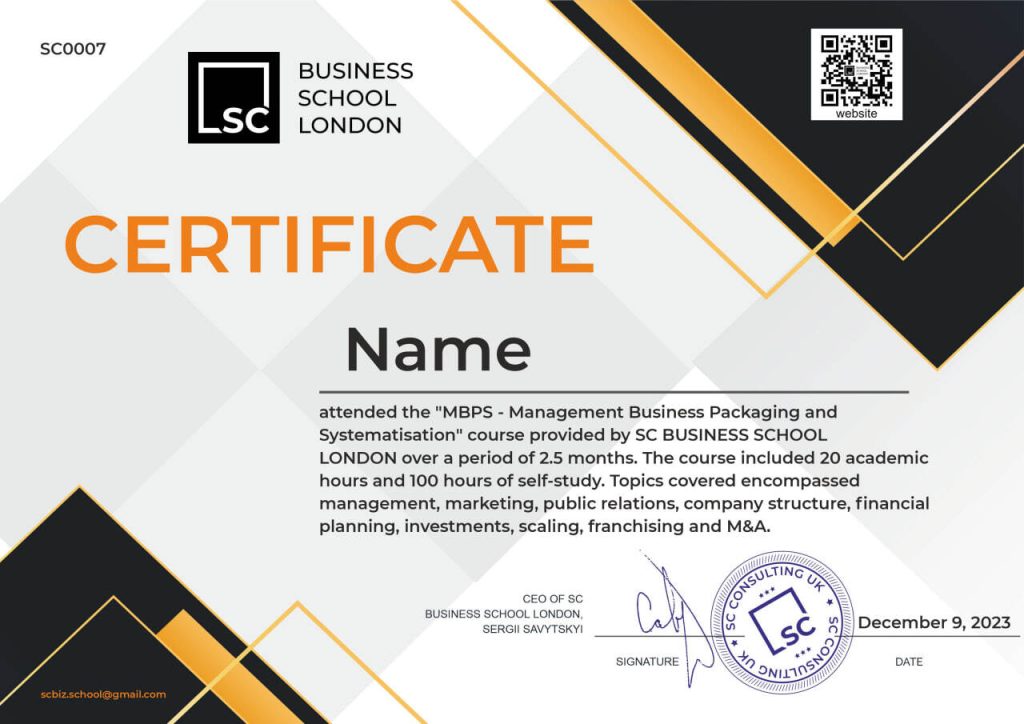
- Each student will receive a certificate of completion of the course
- You will be added to the alumni chat and community
- The top students will receive additional grants to continue their education
- Graduates of the course can receive additional consulting support from SC CONSULTING GROUP
Your certificate is recognised by employers and partners in the UK, the EU, the USA and other countries.
A CPD certificate strengthens your professional reputation and helps you stand out in the job market.
Reviews

«The financial and organizational structure of the company was worked out, and thanks to this we were able to restructure and improve the way in which the company works. We saved considerable time and money by contacting Serhiy and his team.»

«After completing the business school we received a structured and clear explanation of working with finances, and learned how to work with finances — realising that it is not as scary as it seems.»

«4 months after the start of cooperation, I received a fully packaged turnkey business without spending even an hour of my time. I discovered the concept of 'franchise' and understood how it works.»

«We took the business school in order to get a structured company and an understanding of how to properly structure and scale the company.»

«We took the business school in order to package our business for franchising. We realized that the franchise is not as difficult as it seems at first glance. We learned a lot during the packaging process and implemented it in my business.»
Video testimonials
WEBINAR ABOUT THE COURSE
Free webinar about the course, its value and content

What you get
- Information about the structure of the course.
- Answers from the speaker and a detailed understanding of the course content and its value to you in the future.
- Analysis of practical previous cases.
The webinar will be held online.
Duration and bonuses
- Webinar is held monthly by prior agreement.
- The duration is 60-90 minutes depending on the number of participants.
- All webinar participants will have the opportunity to book the course at a discounted rate if desired.
Get tools you can put to work tomorrow
Every few weeks — a practical breakdown on systematising and growing a business.
No spam.
You can unsubscribe at any time.